
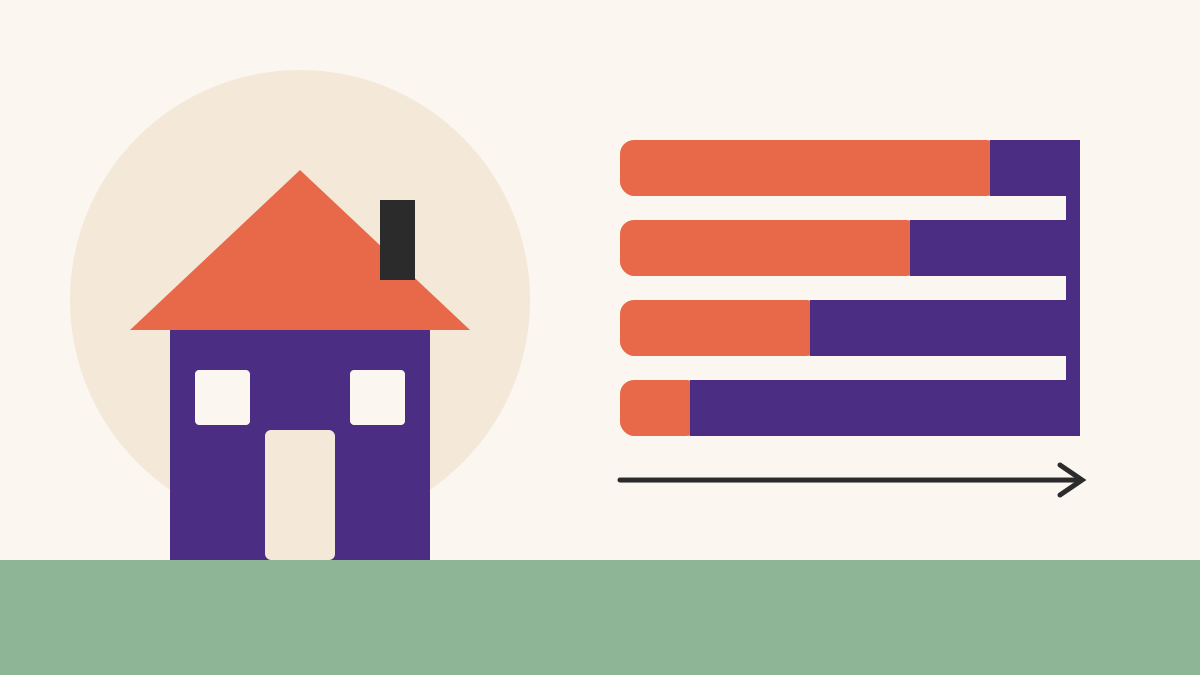
On a standard fixed-rate mortgage, each monthly payment is the same amount, but what that payment does changes every month. Interest is charged on the balance you still owe, so early payments go mostly to interest and later payments go mostly to principal. This gradual shift is called amortization.
Principal, interest, and the rest of the bill
Principal is the money you borrowed. Interest is what the lender charges for lending it. Together they form the core of the payment, sometimes written as “P&I.”
Many monthly mortgage bills include more than that. Property taxes and homeowners insurance are often collected through an escrow account, and some loans add mortgage insurance. Those pieces can change from year to year, which is why a total monthly bill may move even on a fixed-rate loan. This article focuses on the principal and interest portion, which does stay fixed.
Why the split shifts over time
Each month, the lender multiplies the remaining balance by the monthly interest rate (the annual rate divided by 12). That amount is the interest portion. Whatever is left of the fixed payment reduces principal. Next month the balance is a little smaller, so the interest portion is a little smaller, and slightly more goes to principal. The effect starts slowly and builds.
An illustration with round numbers
As an example only, consider a $300,000 loan at a 6% fixed rate over 30 years. Using the standard amortization formula, the principal and interest payment is about $1,799 a month.
| Payment | Interest portion | Principal portion | Balance after |
|---|---|---|---|
| Month 1 | $1,500 | about $299 | about $299,700 |
| Month 121 (year 11) | about $1,255 | about $544 | about $250,500 |
| Month 360 (final) | about $9 | about $1,790 | $0 |
In the first month, $1,500 of the $1,799 payment is interest (6% divided by 12 is 0.5%, and 0.5% of $300,000 is $1,500). After ten years of payments, the balance is still roughly $251,000. In this example, the principal portion does not overtake the interest portion until around year 19. Over the full 30 years, total interest comes to roughly $347,500, more than the original loan amount.
These are illustrative figures; your own amortization schedule, available from your lender or loan documents, shows the exact split for every payment.
What changes the split
- Interest rate. A higher rate makes the interest share larger and slows early principal reduction.
- Loan term. A 15-year loan has a higher payment, but far more of each payment goes to principal from the start, and total interest is much lower.
- Extra principal payments. Any extra amount applied to principal lowers the balance, so every future payment has less interest and more principal. Confirm with your servicer how extra payments are applied.
- Refinancing. Starting a new loan resets the schedule, putting you back at the interest-heavy beginning.
Reading your own schedule
An amortization schedule lists every payment in order, with columns for the interest portion, the principal portion, and the remaining balance. Scanning down it shows how slowly the balance falls at first and how quickly it drops near the end. It also helps when you are weighing a sale or refinance: the balance column tells you roughly what you would still owe at any future date, which matters when estimating the equity you could walk away with.
Key takeaways
- The fixed payment hides a changing mix: interest-heavy early, principal-heavy late.
- Equity from payments builds slowly in the first years of a long loan.
- Shorter terms and extra principal payments reduce total interest the most.
- Escrowed taxes and insurance can change your total bill even when P&I does not.
Looking at your own amortization schedule is one of the simplest ways to understand a mortgage. It shows how much of each payment builds ownership, how much pays for borrowing, and how options like a shorter term or occasional extra payments would change the long-run cost.