
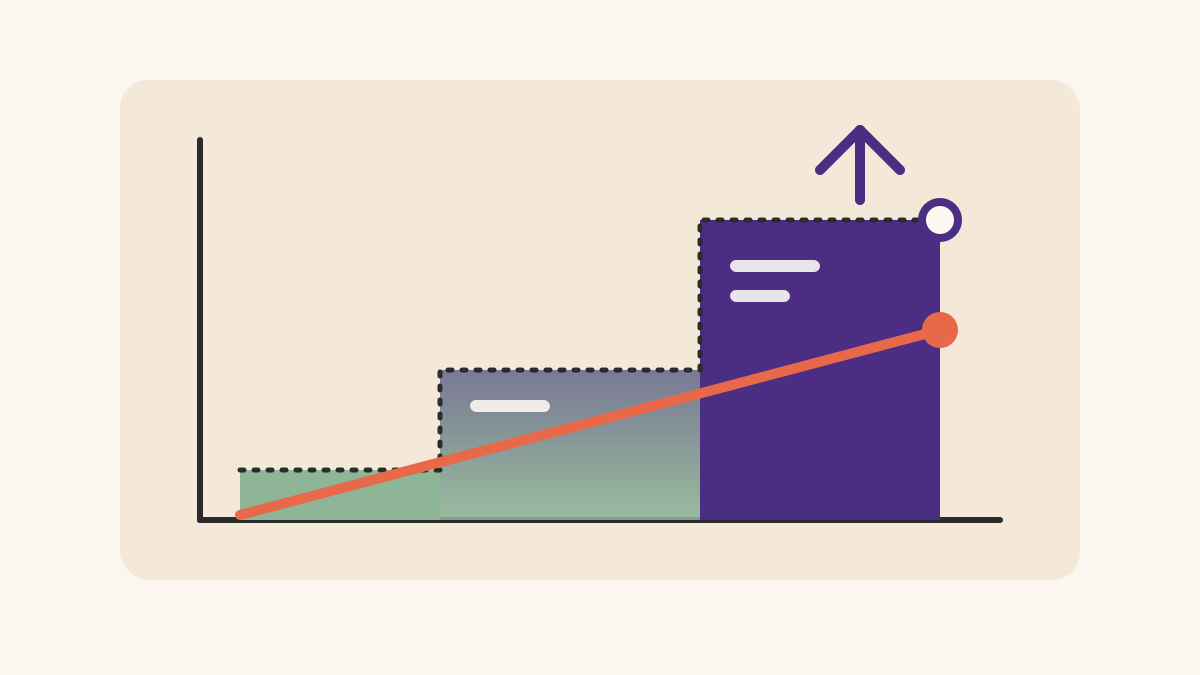
Your marginal tax rate is the rate applied to the last, or next, unit of income you earn. Your effective tax rate is the total tax you pay divided by your total income, which gives an overall average. In a progressive system the effective rate is almost always lower than the marginal rate, and mixing the two up leads to some costly misunderstandings.
How progressive brackets work
Many countries tax income in layers called brackets. Each layer has its own rate, and higher layers carry higher rates. The key point is that each rate applies only to the income that falls inside its own layer. Moving into a higher bracket does not raise the tax on the income below it.
Real brackets, rates, and thresholds differ by country, sometimes by region, and they are adjusted over time. The example below uses a simplified, made-up bracket system purely to show the mechanics.
A worked example with hypothetical brackets
Imagine an invented system with three brackets:
| Taxable income layer | Hypothetical rate |
|---|---|
| 0 to 10,000 | 0% |
| 10,001 to 40,000 | 10% |
| Above 40,000 | 20% |
Now take someone with 60,000 of taxable income:
- The first 10,000 is taxed at 0%, so tax is 0.
- The next 30,000 (from 10,000 to 40,000) is taxed at 10%, so tax is 3,000.
- The remaining 20,000 (from 40,000 to 60,000) is taxed at 20%, so tax is 4,000.
Total tax is 0 + 3,000 + 4,000 = 7,000. The marginal rate is 20%, because any extra income would land in the top layer. The effective rate is 7,000 divided by 60,000, which is about 11.7%. The gap between those two figures is the whole story of a progressive system.
The “raise that costs money” myth
A common fear is that a raise could push you into a higher bracket and leave you worse off. Under bracket-based income tax alone, that does not happen. Using the same made-up system, if income rises from 60,000 to 61,000, only the extra 1,000 is taxed at 20%. Tax goes up by 200, and take-home income still rises by 800.
There are narrower situations where extra income can reduce certain benefits or credits that phase out as earnings rise, so the overall effect can be more complex. Those cases come from specific programme rules, not from the brackets themselves, and they are worth checking in official guidance if you are near such a threshold.
When each rate is useful
Marginal rate
Use the marginal rate to judge the effect of a change at the edge of your income: overtime, a side job, a bonus, or a deduction that lowers taxable income. If a deduction removes 1,000 of taxable income and your marginal rate is 20%, the tax saved in this simplified model is 200.
Effective rate
Use the effective rate to understand your overall tax burden, compare one year with another, or estimate how much of your total income goes to income tax. Some people calculate it against gross income and others against taxable income, so be clear about which version you are looking at.
Common mistakes
- Applying the top bracket rate to all income when estimating tax.
- Turning down extra work out of fear of “jumping a bracket.”
- Comparing your effective rate with someone else’s marginal rate.
- Forgetting that payroll contributions and regional taxes may sit on top of income tax.
Two numbers, two different jobs. The marginal rate tells you what the next unit of income or deduction is worth, while the effective rate shows the overall share of income paid in tax. Keeping them separate makes raises, bonuses, and deductions much easier to reason about, and the official tax authority where you live can confirm the actual brackets that apply to you.